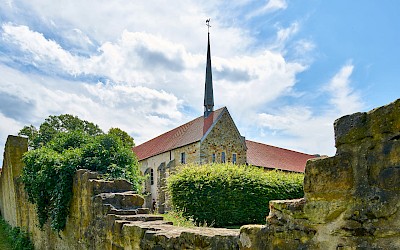
The Hünenborg near Rheine
The Story
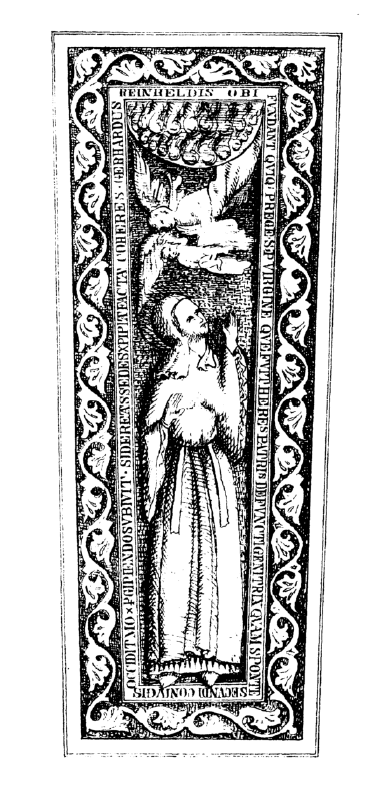
Sünte Rendel is the Low German name for St. Reinhildis, also known as Reinhild of Riesenbeck or Reinhild of Westerkappeln. The saint is particularly associated with Riesenbeck and Westerkappeln in the Tecklenburger Land region. According to the parish of St. Reinhildis in Hörstel, Reinhildis is venerated as a martyr from the Münsterland region. Her relics were brought to Riesenbeck, where her tomb is located in St. Calixtus Church.
According to legend, a young girl named Reinhild was born at the Knüppenhof in Westerkappeln. Her mother and stepfather forced her to do hard farm work, which Sünte Rendel performed without resistance. Only when the bells rang to call people to church did she put down her work.
While she was at church, the horses are said to have continued working in the field on their own. According to tradition, the work was done as if by angels .
Her parents were said to have been so enraged by the girl’s piety that they punished Sünte Rendel and threw her into a well. Angels are said to have rescued her from it. Since she continued to attend church services, her mother finally killed her one day.
Her body was then placed on a cart pulled by two oxen without human guidance. Guided by a divine hand, they are said to have brought Sünte Rendel to Riesenbeck, where she was buried. According to tradition, healing springs subsequently sprang up there.
To this day, the tomb, the Reinhildis Fountain, and the Ossenlock Monument in Riesenbeck serve as reminders of Sünte Rendel.
Between the Legend of the Saint and Folk Tradition

The story of Sünte Rendel is one of the legends of the saints. Such tales often recount stories of exceptional piety, injustices suffered, and miracles that reveal a person’s holiness.
The legend of Reinhildis combines these elements with a motif also found in other folk tales: persecution by one’s own family. Cruel parents or stepparents often serve as the foil to the innocent and virtuous protagonist.
Several miracles also underscore Sünte Rendel’s special status: angels are said to have taken over her work and rescued her from the well. After her death, oxen wandering without a herder are said to have determined the site of her burial. Animals that indicate a holy place through divine guidance also appear in other Christian legends.
Added to this is the motif of the healing spring. In Christian folk belief, springs and wells were often associated with saints, miracles, and special places.
Furthermore, there is a special connection between the legend and Surenburg Castle: The early written record of the Reinhildis legend is linked to Sweder von Schele, who is said to have been a guest at Surenburg Castle in 1629 and to have noticed the saint’s tombstone during a visit to St. Calixtus Church. Thus, Surenburg Castle is not at the center of the legend, but it is part of the historical context in which the legend was passed down.
Did you know that...
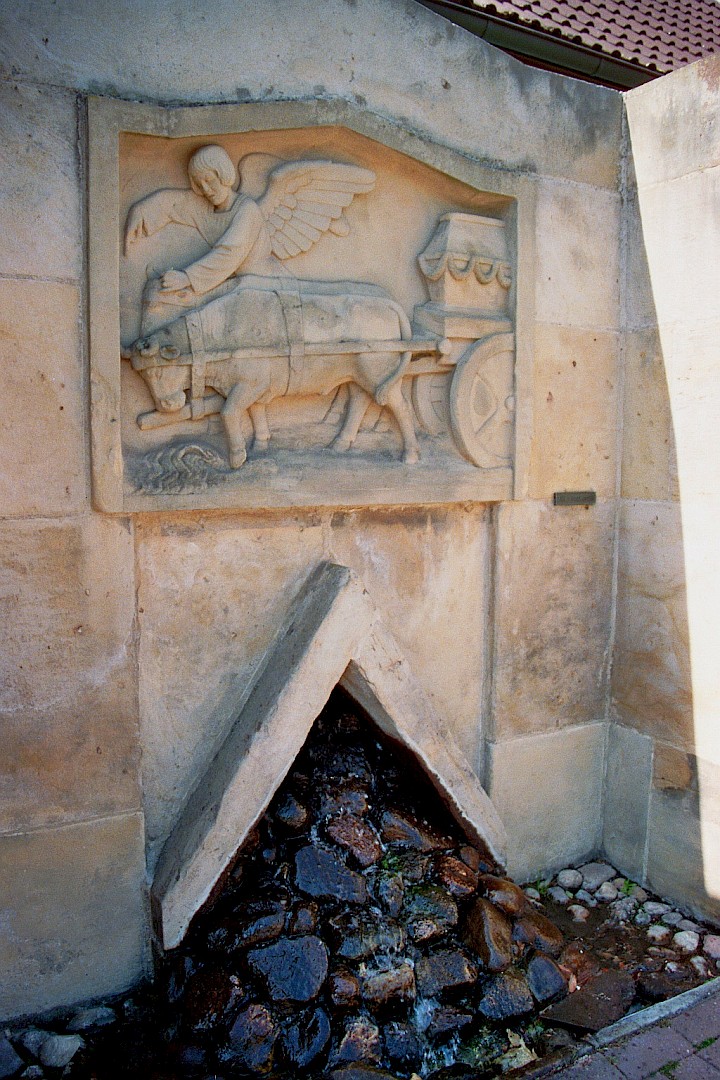
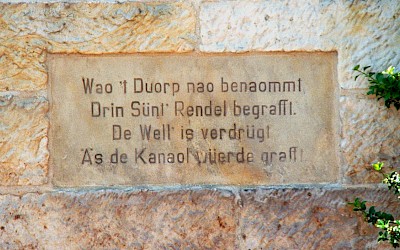
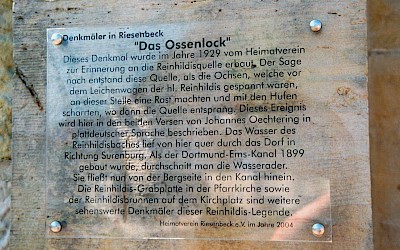
...that, in addition to having its own monument—the Ossenlock Monument in Riesenbeck—the legend appears in several historical prints, and that there are even a few poems based on the story of Sünte Rendel?
Check it out: